Thermography FAQs
Your Questions About Thermal Imaging, Answered
If you've ever stood in a doctor's office, looked at the clipboard, and thought there has to be a better way to stay ahead of my own health, you're not alone. Nearly everyone who walks into my Franklin office says some version of the same thing: "I feel fine, I just want to know what's actually going on in my body."
That's exactly the kind of question thermal imaging was made to answer. Below are the questions I hear most often, answered the way I'd answer them if we were sitting across from each other with a cup of tea.
Where thermal imaging fits in a health care plan
I want to reframe something, because it matters. Most people think of imaging as something you reach for once something has already gone wrong. I would love for you to think of thermal imaging the opposite way: as the very first step, the opening move in a proactive health care plan.
Here is why that changes everything.
It is non-invasive and contactless. You sit in a comfortable room, the camera reads you from a few feet away, and that is the whole appointment. No needles, no compression, no radiation at any point. It is bio-safe enough that we can repeat it as often as your plan calls for, which is exactly what tracking requires.
And tracking is the real power here. One thermal image is a snapshot. The same image taken again in six months is a trend, and a trend is what tells you whether the habits you have been building are actually moving your body in the direction you want. Did the inflammation patterns calm down after you changed your diet? Did the sleep and stress changes you made show up in your thermal signature? That feedback is what makes thermal imaging so useful as the first input in your plan, rather than a last resort after something has already gone wrong.
When your body shows a pattern worth a closer look, thermal imaging has done its job: it pointed to where to look next. From there, follow-up care typically means an ultrasound or a sonogram, ordered and interpreted by your physician. Thermal imaging sits first on that ladder, a low-cost, radiation-free first look that surfaces what deserves a closer look rather than replacing anything.
You and your care provider then have something concrete to work with: a set of patterns, a baseline to watch, and a clear reason to adjust a habit, a supplement, a sleep routine, or a follow-up test. That is the difference between guessing at your health and actually steering it.
What does thermal imaging actually measure?
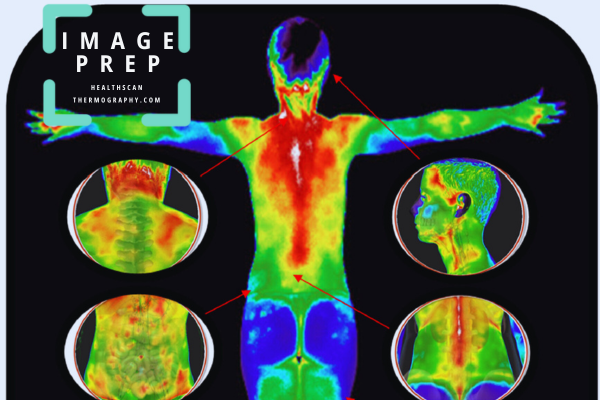
Thermography evaluates subtle temperature variations across the surface of your body. Those variations can correlate with what's happening underneath: your physiological responses and functional changes over time. In plain terms, it gives us clues about your overall wellness that you cannot feel and would not otherwise notice.
Your body runs hot and cold in patterns. When those patterns shift away from your own normal, that shift is information worth paying attention to.
What can thermal imaging reveal, and what are its limits?
Let me be honest with you, because you deserve that. Early signs of inflammation, circulatory concerns, structural weaknesses, and other imbalances have been associated with certain non-optimal thermal patterns imaged through advanced thermography protocols.
What it cannot do is visually detect or diagnose a specific disease. It is not a diagnostic tool, and I will never present it as one.
What it can do is uncover areas that may deserve further conventional testing, and it allows you and your care team to monitor progress over time through the biofeedback of temperature change. Think of it as a first look from the outside in, one that helps you and your doctor decide where to look closer. When a thermal pattern shows something worth a closer look, the usual next step is follow-up care like an ultrasound or a sonogram, ordered and interpreted by your physician. Thermal imaging sits first in that chain, a non-invasive, radiation-free first look, not a replacement for the care that follows.
How can variations in temperature patterns be meaningful?
Everyone has their own baseline thermal signature, like a fingerprint made of heat. When your patterns alter from that baseline, it can pinpoint areas where internal responses, inflammation in particular, are manifesting. Those are functional changes worth discussing with your healthcare provider.
This is why the baseline matters so much. A single image tells a story. Images over time tell you the truth about where that story is heading. Your primary provider can use those readings to discern where to focus, and to spot anything that looks out of step with your unique normal.
What are the advantages over other testing tools?
Thermal imaging is non-invasive, contactless, and painless. There is zero radiation, ever. It detects subtle changes in your surface temperature patterns that are impossible to feel by hand, and it offers a wellness perspective that complements your standard testing rather than replacing it.
No needles. No radiation. No waiting room anxiety. Just information you can act on.
Why do our protocols matter?
This is the part most people never think to ask about, and it's the part I care about most.
Specialized training and standardized protocols, controlling for variables like room temperature, are what ensure consistency from one appointment to the next. That consistency is what allows your images to be compared reliably against computerized digital archives, so notable temperature variations are actually identifiable rather than just guessed at.
A room that's too warm, a body that hasn't acclimated, an uncalibrated camera: any one of those turns useful data into noise. We control for all of it.
Why does the quality of the equipment matter?
The accuracy and clarity of your results depend on the infrared camera being used. Our Med-Hot ultra-high resolution FLIR A-700 camera systems and patented software provide detailed thermal images that allow subtle changes in heat patterns to be identified.
Professional-grade equipment is the difference between a clear, actionable result and a blurry one you can't trust. You deserve the former.
Who actually interprets the images?
This question comes up a lot, and I want to answer it directly.
Thermal images are analyzed by trained professionals with expertise in thermographic imaging. Every one of our reports is reviewed by experts, including MDs, DOs, and Licensed Naturopathic Physicians, trained to interpret thermal patterns and variances and to provide you with detailed, meaningful insights.
My own background is 23 years in massage therapy and wellness coaching, which is why I tend to notice things in a person's body before they say a word. But reading your images is a job for the physician panel, and I'm glad it is. You get both: my eyes and my care, plus credentialed expertise on your report.
Which thermal imaging session is right for me?
We offer three:
Full Body Thermal Imaging Study. Head to toe, every image captured, the most complete picture of your wellness patterns. This is our most popular option.
Half Body Thermal Imaging Study. Everything except the arms, hands, legs, and feet. The head and general core of the body.
Breast + Thermal Imaging Study. Focused specifically on the chest and breast area for breast health imaging.
Not sure which one fits what you're trying to understand? Ask me, or book directly at https://healthscanthermography.com/thermography-appointments and we'll sort it out before your appointment.
What else can I combine with my session?
Thermal imaging tells one part of the story. Two other tools fill in pieces that imaging alone can't reach, and both are available as an add-on to your thermal imaging session or on their own.
Metals + Minerals OligoScan. This one reads what's stored in your tissue rather than what's circulating in your blood. It measures the bioavailability of minerals and trace elements and the rate of toxic metals in living tissue, taken from the surface of your hand, and it gives you results in real time with the possibility of immediate interpretation. Over time, you can watch the trend line move. Blood shows you what's circulating, hair shows you what happened weeks ago, urine shows you what your body is clearing. The OligoScan shows you what is actually sitting in your tissue. They complement each other beautifully. You can book one here: https://healthscanthermography.com/metals-minerals-scan
Bioresonance Scan. A non-invasive tool that explores frequency patterns related to a wide range of energetic representations in the body, including organs, cells, and other systems. It generates a visual summary highlighting frequency variances compared to established blueprint frequencies, giving you personalized wellness insights meant to support your own mindfulness and self-care. And yes, it can be done remotely from a short voice recording, which makes it a wonderful option for family members or clients who aren't local. You can book the Bioresonance Scan here: https://healthscanthermography.com/bioresonance-scan
The Complete Insights Bundle brings all three together with a consultation to walk you through every report, so you leave with answers instead of guesswork. You can see everything included here: https://healthscanthermography.com/all-scans
A few quick extras people ask about
Are these tools safe for children and pets? The frequency-based technology is entirely safe for babies and pets, and there's a dedicated version designed for our four-legged family members.
Can the OligoScan be done on children? Yes, with a few requirements: minimum age 15, minimum weight 66 pounds, and minimum height 3'3".
How often should I come back? Your energy and your body fluctuate with life's demands, so a single reading is a snapshot, not a trend line. For the Bioresonance Scan, monthly is the rhythm that reveals a trajectory. For thermal imaging, many of my clients return every six months to see how their patterns are shifting.
The bottom line
You don't need to be sick to want better information about your body. You just need to be curious, and a little bit proactive.
Our health is our greatest treasure, and it is up to us to be good stewards of it. I'd love to help you be a better steward of yours.
If your question isn't answered here, ask me directly. Nobody has ever asked me something I thought was silly.
Ready to see your own patterns? Book your thermal imaging session at our Franklin office here: https://healthscanthermography.com/thermography-appointments
Or reach out and let's talk through which option is right for you. I would rather spend ten minutes helping you choose the right session than have you pay for one you didn't need.
And once your report comes back, you don't have to read it alone. Your images are reviewed by our physician panel, and if you'd like to sit down with me and walk through what yours mean for your next steps, I offer a private 20-minute report consultation for $75. Book one here: https://melindaloomentor.as.me/thermalconsult
To better health,
Melinda
Health Scan Thermography offers a safe, non-invasive way to empower you as an active partner in your wellness journey. Thermal imaging is not a diagnostic tool and does not detect, diagnose, treat, or cure any disease or condition. Always consult your physician before starting, changing, or stopping any health program, and use these insights alongside your regular medical care.


